Inclusive Voices

Image copyright Adobe Stock
When using information search tools and citing sources, it's important to consider a wide range of scholars and viewpoints, especially those that are non-dominant or underrepresented, including Indigenous knowledge, Black perspectives, researchers from the Global South, and women scientists. Recognizing the multiplicity and complexity of these voices can help you broaden your perspective on a particular topic.
In the academic context, you might also want to question the established structure of authority and credibility. Are metrics such as citation counts and impact factor the only ways to assess the quality of scholarly content? What are other types of information beyond peer-reviewed books and journal articles that may bring out voices directly from the community? These could include primary sources such as oral histories, photographs, and drawings, as well as community-based publications such as local newspapers published in languages other than English and French. The goal of this module is to help you understand better your own assumptions and biases in relation to others and provide you with practical strategies to actively fill in gaps during your research and writing process.
Avoiding bias
It's normal—and important!—to have personal opinions when researching and writing. But it's essential to be aware of your own biases and not let them limit the perspectives that you consider. While searching for information:
- Be aware of and acknowledge confirmation bias while conducting research.
- Look into authors’ backgrounds by checking their profiles and other publications.
- Find your unique perspectives on your research, understand why you care about this topic, how it influences your life or community, and how you have come to know about different arguments on the research topic.
- Ask for help from professors, subject librarians, community members, or other experts to get guidance on diversifying your sources.
Video: What is citational justice? By Arizona University Libraries
Inclusive citation
As you gather information, keep these questions in mind:
- Who might be relevant to cite?
- Are there sources from particular groups of authors in your field or in other fields that you might have overlooked? Have certain voices been more privileged than others in the past?
- Are there other groups or authors who might express different opinions on your research topic?
- How can you make your work accessible to diverse audiences in the future?
Good practices:
- Cite authors because of their ideas and work, not solely because of their identity.
- Avoid limiting authors’ expertise to issues related only to their identity.
- Don’t assume that a writer or artist who identifies with a group speaks for everyone in that group.
Broaden your search
- Experiment with different ways to identify experts and relevant voices related to a topic, such as articles, professional associations, social media, news, podcasts, primary sources, etc.
- Consult research guides from Concordia Library or other libraries to help you identify information sources, such as the Black Studies subject guide, First Peoples Studies subject guide, and Primary Sources guide.
- Try various search terms to have better inclusivity and consider the terms used by different communities that are relevant to your research.
- Keep in mind regional differences when searching and use search terms that reflect a given location, especially if you need resources from specific geographic areas or cultures outside the scope of academic information sources.
- Change the way that search results are sorted in databases and search engines, such as using "Date-newest" instead of the default "Relevance" to ensure that you are not limited by what search algorithms bring to the top of your results.
Broaden your perspective
- Engage in genuine research and learning by critically evaluating sources, considering authors' perspectives, motivations, and evidence.
- Challenge "bothsidesism" and "false balance" (that is, misrepresenting two viewpoints on an issue as being equally valid despite the evidence). Be sure to evaluate sources and opinions critically.
- Explore alternative opinions and develop deep understandings of your topic.
- Be open to rejecting unsound arguments and incorporating resources from different voices and communities to gain new insights.
Furthermore, depending on your projects and the communities you want to engage, sometimes it is not enough to just "consult," take what is needed, and leave. It is crucial to build trust by involving the community, identifying common questions, and learning together. And as discussed in the Data Sovereignty & Expansive Citation Concordia Library guide by Rudi Aker, to ensure respectful engagement with communities you should also consider the following approaches: "Familiarize yourself with relevant data sovereignty frameworks and proper cultural protocols; acknowledge the rightful owners of data, cultural, and intellectual property; promote community-led and community-authored data and research initiatives."
This page is adapted from the Inclusive Citation guide by Andrea Baer, CC BY-NC-SA 4.0 International License.
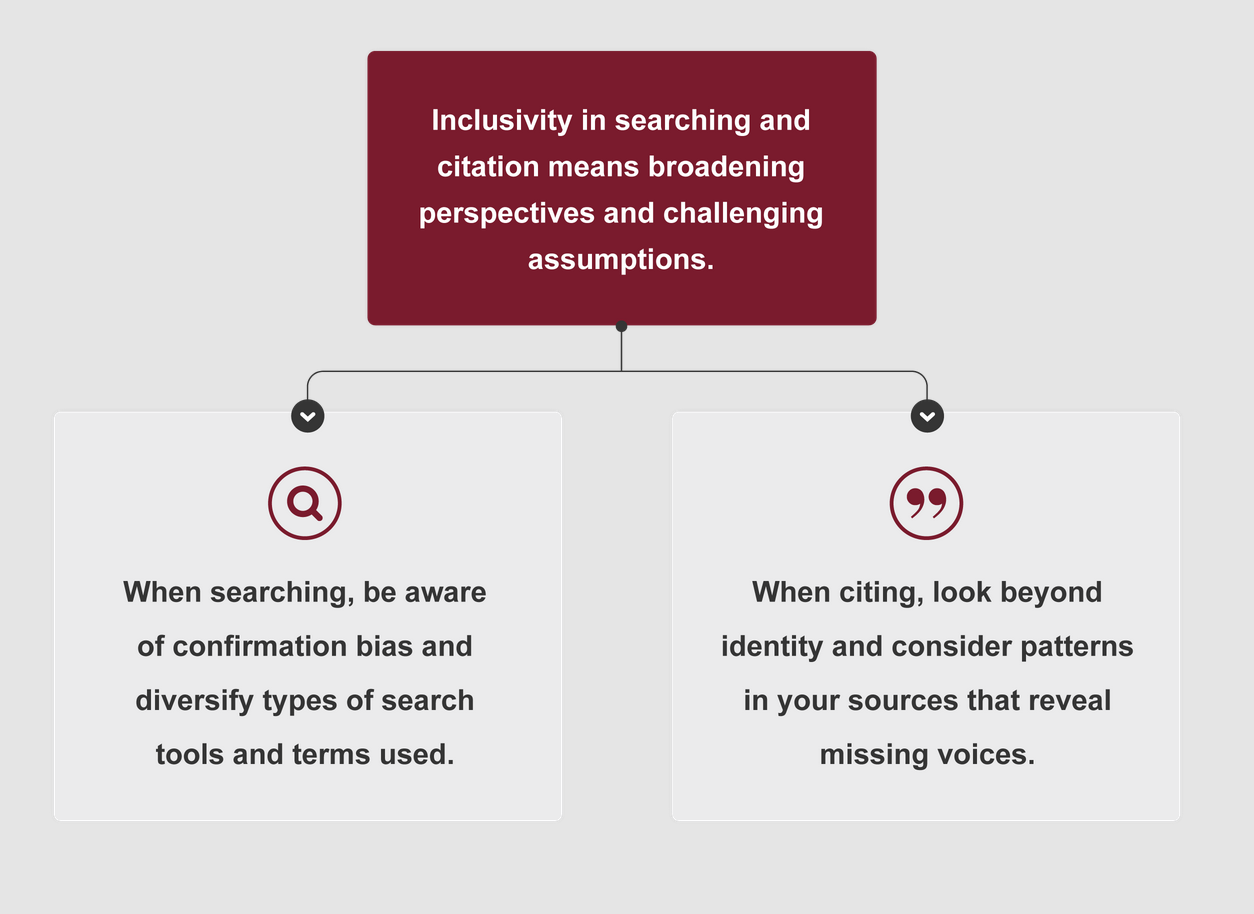
click image to enlarge
Resources


References
Baer, Andrea. Inclusive Citation.
Casad, Bettina J. and Luebering, J.E. Confirmation Bias. Encyclopedia Britannica. 2024.
Johnson, Jessica and Ermacora, Ryan. Anyox. Snag Pile Films. 2022.
Thomson, Jimmy. Meet the scientists embracing traditional Indigenous knowledge. The Narwhal. 2019.
University of Arizona Libraries. The Importance of Citational Justice.