Misinformation and Disinformation

Image copyright Adobe Stock
Information Disorder
In an information
environment shaped by pervasive algorithms,
the attention economy, engagement, and
polarization, how do we determine truth? How
do we know which sources of information to
trust? These questions are becoming
increasingly difficult to answer, and even
more so as “disinformation that is designed
to provoke an emotional reaction can
flourish in these spaces” (Wardle,
2018).
In 2016, Oxford Dictionaries selected "post-truth" as the Word of the Year, defining this as: “circumstances in which objective facts are less influential in shaping public opinion than appeals to emotion and personal belief.”
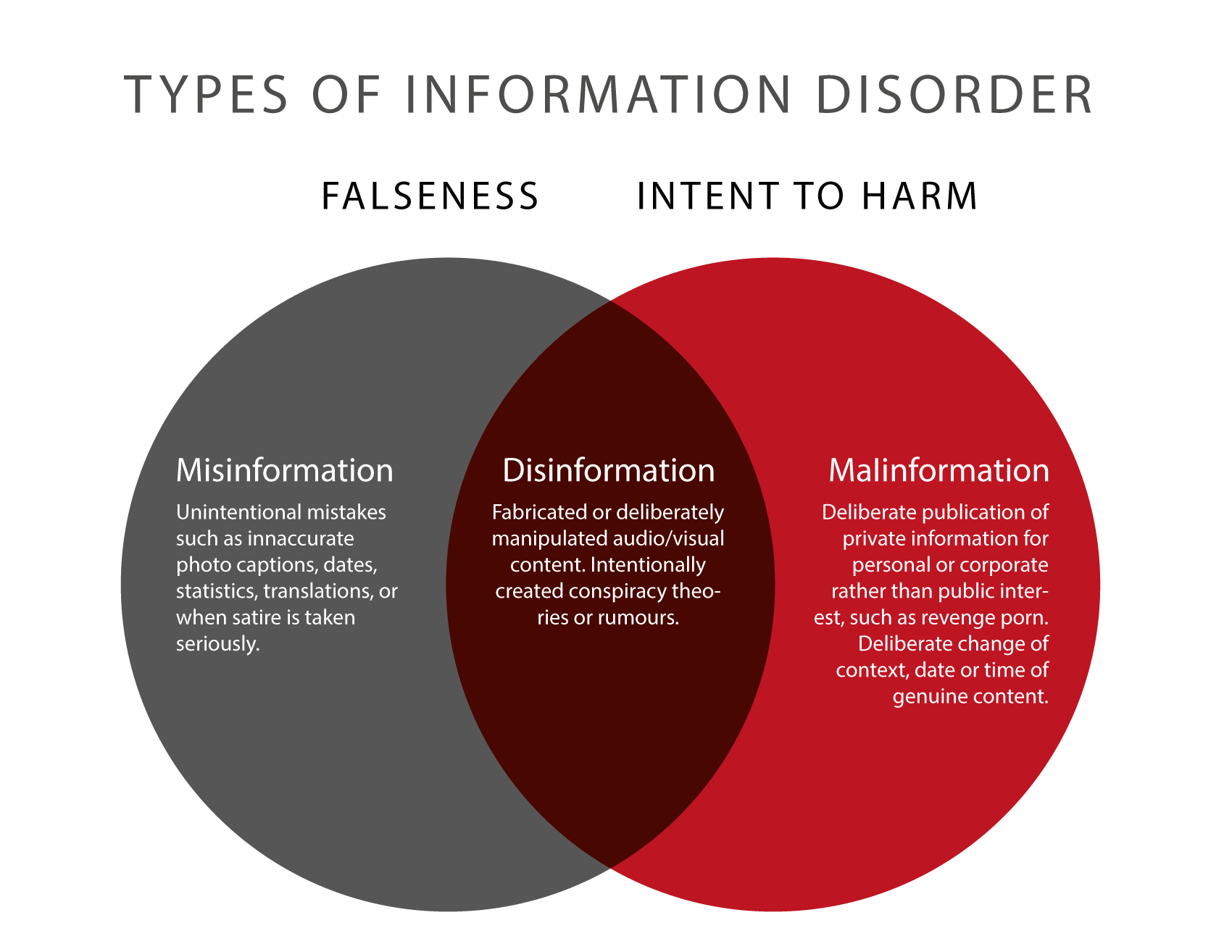
A venn diagram of types of information disorder.
Claire Wardle, a world-renowned expert in this field, has used “information disorder” as an umbrella term for the various types of false, misleading, manipulated, or deceptive information that we have seen flourish in recent years, although it’s important to note that propaganda, conspiracy theories, smear campaigns, and the like are by no means new (see more historical examples).
- Misinformation: Unintentional mistakes such as inaccurate photo captions, dates, statistics, translations, or when satire is taken seriously.
- Disinformation: Fabricated or deliberately manipulated audio/visual content. Intentionally created conspiracy theories or rumours.
- Malinformation: Deliberate publication of private information for personal or corporate rather than public interest, such as revenge porn. Deliberate change of context, date or time of genuine content.
3 Types of Information Disorder graphic by Claire Wardle & Hossein Derakshan, licensed under CC BY-NC-ND 3.0 license
Text from Introduction to College Research by Walter D. Butler, Aloha Sargent, and Kelsey Smith, licensed under a CC BY 4.0 International license.
Fake News
The term “fake news” has been distorted at this point but is usually meant to refer to mis- or disinformation in news media or information shared on social media.
Fake news has been defined as “information deliberately fabricated and published with the intention to deceive and mislead others into believing falsehoods or doubting verifiable facts” (Ethical Journalism Network, 2017). Some indications of fake news include:
- Information or claims that no other sources are reporting
- Information or claims that contradict science, known history, or other facts that we know to be true
- An author with no credentials or relevant connection to the subject
- A flashy headline that evokes a strong emotional response or misrepresents the contents of the source
- Out-of-context or manipulated quotes, studies, or media
Our emotions and cognitive biases naturally impact the effect that mis- and disinformation can have. In an interview, Wardle points out that while people tend to assume that they’re thinking about information rationally, their emotions also affect how they react to it. She is quoted as saying, “If a piece of information makes you feel scared, angry, disproportionately upset, or even smug, then it’s worth doing additional checks or slowing down before re-sharing it. We’re less likely to be critical of information that reinforces our worldview or taps into our deep-seated emotional responses” (Vongkiatkajorn, 2018).
Text adapted from What is fake news by University of Victoria Libraries, CC BY 4.0 International license
A CBC News segment from 2019
Predatory Publishing
Predatory journals and book publishers are primarily interested in revenue and advertising. In that sense, some publications are less interested in making rigorous scientific works accessible and more committed to attracting attention. Because of this, one major source of misinformation in academia is predatory publishing. There is no formal accountability structure for academic publishing, and this makes identifying and removing misinformation from unscrupulous publishers a community effort.
Academic Fraud
As academic publications and the underlying research methods evolve, new forms of fraud emerge. Fraud can be thought of as falling mainly within the following categories in academic context:
- Fabricated or misleadingly edited datasets
- Manipulated data processing routines
- Interpretations which knowingly do not line up with the collected data
- Misattributed, stolen, or improperly cited writing or data
- Sabotaging other people’s experiments or research processes
- Helping others with any of the above
Some fields have recently been reckoning with a “reproducibility crisis” when a meaningful portion of the findings on which the field is based are found to be difficult to corroborate independently (Bausell, 2021). This is often seen in medical sciences, since although experimental procedures may seem objective and rigorous to the scientists that author them, specialization and isolation across different niches mean that much of the practical, “tacit” (non-verbal or non-written) knowledge used in the undertaking of experiments and the analysis of results may be hard to communicate to others. Reproducibility is important because it confirms that a field’s pre-existing knowledge is in fact demonstrable and verifiable. In this complex knowledge creation and consumption environment, malicious behavior becomes difficult to detect and even more difficult to keep people accountable for.
In the same way that predatory publishing is in practice quite field-specific, modes of knowledge maintenance and creation which depart from the so-called “scientific method,” do not focus on verifying predictive hypotheses, and do not collect data via measurement or ethnographic means tend to have a more complex relationship to identifying fraud and keeping its authors accountable. There, arguments can be in fact made in bad faith and still find practical use to scholars, regardless of their awareness of the fraud.
Industry funded research and conflict of interest
Sometimes academic research may appear to legitimate and carried out with accepted standards of accuracy and reliability, but closer examination reveals that the study was funded by a company, industry collective, political lobbyist, or other group that benefits in some way from the research having a particular outcome. One example is the Weinberg Group, a firm that has been tied to organizing and funding centres, publications, and individual researchers that published research that minimized health impacts of tobacco, chemicals, and alcohol on behalf of companies making profit in those industries (Thacker, 2006).
Most reputable journals require disclosure of funding sources and authors’ conflicts of interest. The fact that a study is funded by a particular industry, company, or interest does not negate the results—it must be read carefully—but often the interpretation, extrapolation, or communication of the results may be spun in a direction that is favourable to the funder.
Fake papers
One of the most straightforward types of academic misinformation to identify is fake papers. This can include articles that are completely fabricated and/or ghost-written (that is, written by someone hired by the named author(s)) or generated by AI. The paper is then submitted to a journal in order to get a publication credit for the named author(s), or in some cases, as a deliberate hoax. Some hoaxes with fake papers have been intended to demonstrate flaws with journal publishing systems or to make a commentary on a particular academic field (Reilly, 2020).
The old yet burgeoning phenomenon of “paper mills” is also plaguing journals. Paper mills are companies that write academic articles on order from “customers”—scientists and scholars who then submit the articles for publication in journals (Else and Van Noorden, 2021). It is often difficult for reviewers and publishers to detect these papers, but image manipulation and similarities in data features across submissions can be signs of paper mill production.
Academic Misinformation
According to the World Health Organization, vaccination programs currently prevent 4 to 5 million deaths every year (WHO). This is just one example of why research, even though it can be difficult, is worth the effort of learning how to find the information you need. In this section, we discuss a spectrum of academic misinformation so you can be better prepared to distinguish a good reference from a bad one. As an undergraduate student, you are not personally responsible for uncovering all problems with everything you read, especially as you are introduced to traditions of knowledge you are not familiar with. Learning how to be critical of media, journalistic or scientific, is just one of the skills that secondary education teaches.
Academic information is not immune to information disorder. This can range from unclear science to mistakes and bad science to malicious misuse of data to fraud and complete fabrication. Some misinformation in the academic context can nevertheless come from trusted sources, when it is the authors themselves that are being unscrupulous. Because research is such a specialized and complex project, it can often be difficult for people not familiar with a project’s questions and methods to fully assess the accuracy of specific claims and interpretations. Peer review is not a fool-proof process, especially in recent years where academic overwork and low funding has made it difficult to find reviewers for journal articles. It can also be difficult to differentiate fraud from honest mistakes. In this difficult situation, some researchers – whether out of desperation, malice, or both – have falsified data, overinterpreted experiments, sensationalized interpretations, or made unsubstantiated claims about the reach of their work. There is a large spectrum of academic fraud, ranging from discrete manipulations of real data to full on fabrication.
The Retraction Watch blog and database track publications that have been retracted (yet often still cited!) and shed light on misconduct and misinformation in academic publishing.
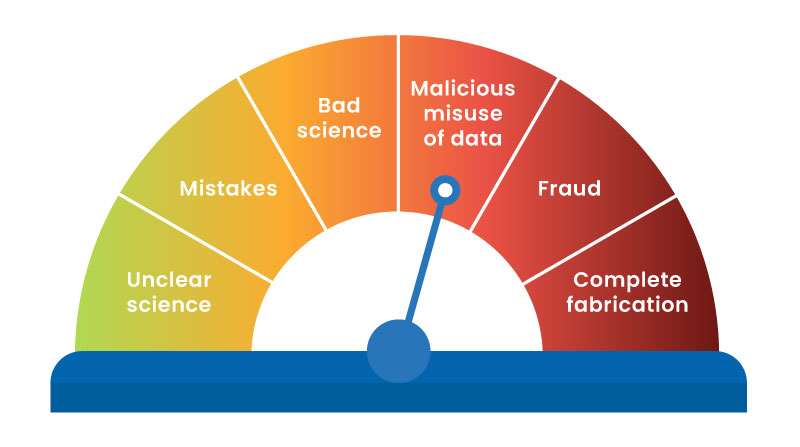
A meter ranking kinds of misinformation, from bad to worse.
Resources



References
Bausell, R. Barker. The Problem With Science: The Reproducibility Crisis and What To Do About It. 2021.
Else, Holly and Richard van Noorden. The Fight Against Fake-Paper Factories That Churn Out Sham Science Nature Volume 591, Issue 7851. 516-519. 2021.
Ethical Journalism Network. Fake News: How the Business of the Digital Age Threatens Democracy. Inside Ethics Blog. 2017.
Oxford Languages Blog. Oxford Word of the Year 2016. Oxford University Press. 2016.
Reilly, Ian. Public Deception as Ideological and Institutional Critique: On the Limits and Possibilities of Academic Hoaxing. Canadian Journal of Communication. Volume 45, Issue 2. 265-285. 2020.
Thacker, P.D. The Weinberg Proposal. Environmental Science and Technology. Volume 40, Issue 9. 2868-2869. 2006.
Vongkiatkajorn, Kanyakrit. Here's How You Can Fight Back Against Disinformation. Mother Jones. August 9 2018.
Wardle, Claire. Information Disorder, Pt. 1: The Essential Glossary. Blog. July 9 2018.
World Health Organization. Immunization. 2019.