Platform Neutrality


Introduction
Since the early 2000s, the explosion of self-publishing technology and social media sites has made it so that everyone with an internet connection and a smart phone or computer can be a content creator. Anyone can go viral with a simple meme or video being seen by millions. Social media platforms are firmly integrated in many societies, but their role is incredibly complex due to the monetization of user-created content and personal information about users. The significance of social media has increased in our daily lives since it has become the place where people need to make connections and post content if they want to successfully convey their message to others. Social media platforms have certainly allowed many individuals and groups to form social connections and spread information in positive ways. But the inverse is also true: social media is particularly suited to spreading misinformation, divisiveness, and hate. Social media companies have come to be an essential factor for public discourse, but they are also private businesses whose only goal is to profit financially on users’ content and personal information.
Questions about social platforms' responsibilities
In the complicated information landscape, many questions arise that cannot be easily answered. Here are some of the as-yet unanswered questions about social platforms’ legal and ethical responsibilities regarding content that their users post.
- When hateful / violent content or deliberate misinformation is posted, are platforms responsible for taking it down, or blocking it in the first place?
- Can companies who only want to make a profit be relied on to make decisions that are beneficial to society?
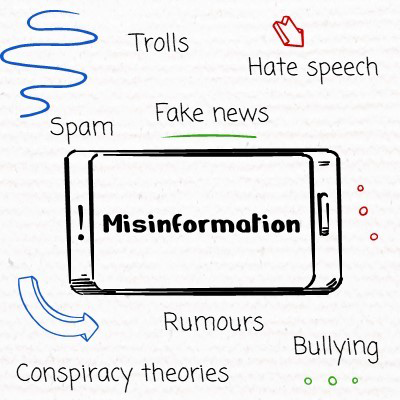
Image created using a presentation template by Slidesgo.
Questions about openness
- If content is regulated, who decides what is censored? If governments are allowed to decide, free expression is in danger, and socially marginalized or vulnerable groups might be excluded.
- When only a few giant companies dominate the internet landscape (i.e., Google, Facebook, and Amazon), how can we ensure that the information we seek and services we use are transparent and fair?
We can’t begin to answer these questions here, but some governments and non-governmental organizations have started taking measures to check the powers of influential platforms.
Measures to review content and limit monopolies
Some social platforms have responded to pressure to moderate content, implementing policies that can include:
- Verifying accounts claimed by well-known figures (such as politicians and celebrities)
- Restricting or banning political ads
- Adding fact-checking labels on potential misinformation
- Labeling accounts run by governmental or state-sponsored media
However, the long-term implementation of these measures is up to the whims of the platforms’ CEOs and are subject to change.
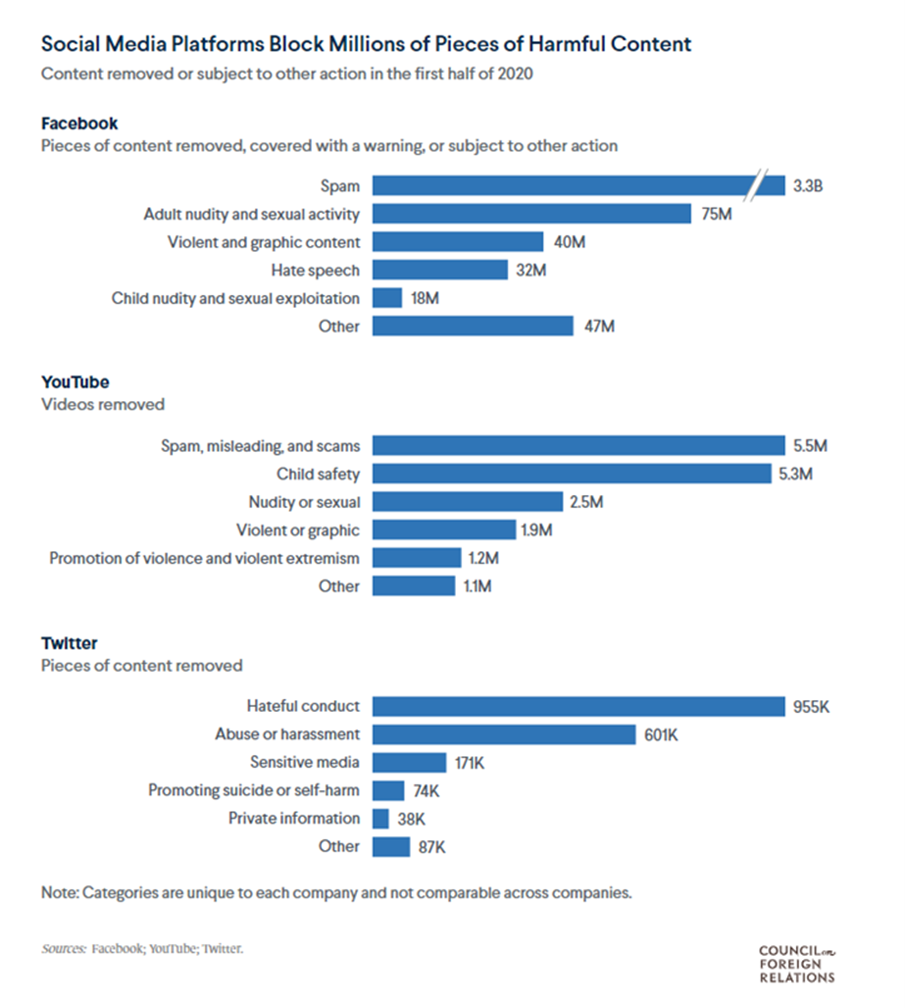
Image sources: Anshu Siripurapu and Will Merrow. Council on Foreign Relations Social Media and Online Speech. Council on Foreign Relations, 2021 February 9. CC BY-NC-ND 4.0.
In addition to content moderation, a key facet of platform neutrality is whether online platforms display all content that is relevant to users equally, or whether they design feeds and search results in ways that benefit the company. Tech giants like Amazon, Facebook, and Google certainly shape the content that is displayed on their sites in order to increase their profits. For example, according to an analysis conducted in 2020, 65% of Google searches resulted in people finding the information they needed through previews on the search screen, or from websites/products owned by Google. Many countries are introducing laws that attempt to stop online platforms from discriminating in favour of their own services. For example, the European Union passed the Digital Markets Act in 2022 that designated certain large tech companies as “gatekeepers” and required them to give the same access to their competitors’ information and products as to their own. Other legislation designed to regulate monopolistic business practices and protect privacy have been passed or proposed in many countries including India, the US, Germany, South Korea, and France. In Canada, bill C-18 (voted 2022) resulted in Meta (the parent company of Facebook, Instagram and WhatsApp) to remove news content from its platforms, with Google also considering a similar strategy.
Conclusion
To summarize, using social media platforms and online service providers is a way of life for most of us. These platforms promote digital commerce, innovation, and both personal and business communication. The platforms go beyond exchanges of information and knowledge by enabling collaboration, community building, and activism. Based on the function these platforms serve and the power they retain, one might argue that they have a responsibility to maintain neutrality, acting as intermediaries and bringing people together in digital spaces. However, in practice, platform neutrality is not a realistic outcome when it’s dependent on the world’s largest for-profit companies. Cyberspace does not belong to a single country, and there is no consensus on how digital platforms should be regulated. What do you think – how can balance be found among the sometimes-contradictory values of freedom of speech, free commerce, social responsibility, respectful discourse, and protection of vulnerable groups?
Quiz
Activities

Let’s reflect on the complicated topic of platform neutrality.

Write approximately 200 words to answer the question: what do you think are social platforms’ legal and ethical responsibilities regarding what is posted or offered through their platforms?

This activity should take about 10-15 minutes to complete.
This activity is meant to spark your thinking about how you share the content you create.
Open a video on your phone that you’ve previously recorded. If you haven’t recorded one before, follow these instructions to record videos with Android or record videos with iPhone. You can also visit the Technology Sandbox to borrow equipment for creating videos. As you look at your video, think about: where did you share this video, or where might you share it with others? Do you think you should be allowed to post this video if it showed violent, hateful, or otherwise harmful content?
This activity should take about 5 minutes to complete.
This activity allows you to discover how search engines shape the results you see.
Watch this video about how Google shapes and displays search results from the Washington Post. Next, think about the most recent web search you did. If you use Google, how easy is it to get beyond Google-sponsored content? If you use a different search engine, like Duck Duck Go, do you get better or more transparent results—or at least results that aren’t Google products?
This activity should take about 5 minutes to complete.
Are you an undergraduate student participating in the FutureBound program?
After reviewing the content and completing the
activities for one of
the Things, you can complete a
reflection form
to have it count as one activity towards your
Digital Capabilities & Mindsets certificate!
Resources

Digital dominance
Book edited by Moore, M., & Tambini, D. about the the global power of new digital monopolies including Google, Amazon, Facebook and Apple. Available in the Concordia Library.
See more
What obligation do social media platforms have...?
What obligation do social media platforms have to the greater good? TED Talk by Eli Pariser on how to create trustworthy online communities.
See more
References
Siripurapu, A. and Merrow, W. Council on Foreign Relations Social Media and Online Speech. Council on Foreign Relations, 2021, February 9.
Gallant, D. What About Social-Media Neutrality? The Wallstreet Journal, 2018 January 28.
Huddleston, T. How Much Revenue Tech Giants Like Amazon and Apple Make Per Minute. CNBC, 2021 May 1.