Information Source Types

Image copyright Adobe Stock
When learning to research, it can be useful to know roughly which categories of resources you might encounter. As explained in the how to find primary sources guide, there are many types of information and many ways to classify them. This unit gives a brief overview of some common types of information sources, then discusses their audiences, how they’re produced, their purposes, and their lifecycles. Becoming more familiar with these will allow you to find your bearings more rapidly when encountering new information or new kinds of information.
Types of Information
Between millennia of writing and the variety of new algorithmically generated content, most information searches yield too many results rather than too few. Knowing what kind of information is a good fit for your purposes will make your information gathering process more effective.
Video from California State University–Northridge Library that details some types of information and a classification example.
Audience
First ask yourself: why are you looking for information? If your sources’ intended audience and your intended purpose don’t clearly line up, you may need to think through or explain why you are bringing in unexpected sources. For example, journal articles were meant to be read by other scholars, and this is reflected in their formatting: they all cite their sources in well-defined formats, they include bibliographies, and they are given keywords and identifiers to be easily connected to prior work and context.
On the other hand, social media posts are written or shared primarily for the poster’s followers frequently without citations or context, but they can be representative of public or community thought at a particular moment.
Different audiences have different expectations about vetting processes. Journalists tend to have fact-checkers, but some newspapers often include partisan information. Many media publishers are for-profit companies, and this often encourages shocking, sellable content rather than accurate, accessible and critical content. Research articles tend to be peer-reviewed (where other researchers have reviewed the evidence and confirmed that it is theoretically or scientifically sound), and while this is not a perfect process, it ensures a level of adherence to the norms expected by the audience.
Purpose
This idea that the format of a resource can indicate its likely audience also helps us understand the original author’s motivation. When you find a resource of relevance to your topic, ask yourself why it was written. Is it reviewing research precedents to offer an interpretation of new experiments in the light of earlier accepted facts? This will probably involve getting experts to review the information and make sure it does this as clearly as possible.
Perhaps it was written to reflect someone’s perspective on a topic they might not have studied extensively. This is not necessarily a less valuable record: in aggregate, people’s written opinions give us valuable information about the trends and values at a specific time and place in human culture. Or maybe you are close to that person or community, and you simply genuinely care about their opinion.
There is no absolute hierarchy of valuable information, but there can be strong expectations of accuracy, style and tone depending on the context in which you are writing. For a university course, librarians and faculty can help you practice how to use and cite different sources: see, for example, our resource on what sources your professor might expect. In professional settings, the types of sources you use will depend on your field and the culture of your organization.
Different Genres of Sources
It’s not because a resource doesn’t fit in a standard information category that it isn’t worth considering as part of your learning and research process. For example, it took a long time for video games or social media to be considered primary sources, but there are now entire, very active fields dedicated to historicizing and contextualizing the importance of these media.
Echoing the Inclusive Voices unit, think of formats used by people in more marginalized positions in the social realm you are investigating. For example, if you’re studying open source programmers, consider looking at web resources like Stack Exchange (a question and answer site) or web forums to learn a different perspective on problem solving and socializing than what might be documented in interviews or sociology of computing publications. If you study knitters, you may want to include some exchanges and files from a Ravelry (community site for knitters) page even if that is not a common occurrence in academic literature. Because these sources took less resources to access and contribute to, they can often be more inclusive of marginalized or minority participants.
Information Lifecycle
Finally, remember that information is not static. Websites fall out of service, newspaper columns lose their context as society evolves, and may be hard to interpret with the perspective of the time at which they were written. Archivists, historians and librarians are experts at recovering this original context and meaning, but they are also helpful when considering how an older source might be relevant today.
It is not enough to think of why, how, by whom and for whom a resource was made public or accessible, it also is often helpful to consider when that resource is from. What had to happen for you to be able to find it? Is the original source or format accessible? Was it made available through a research library / archive, or did a private institution republish it? Either way, it is always worthwhile to take the time to consider the mission of the institutions involved, and how this might shape what information they make accessible. In other words, consider the lifecycle of an information resource, and the various actors involved in creating, publishing, maintaining and sometimes updating that resource.
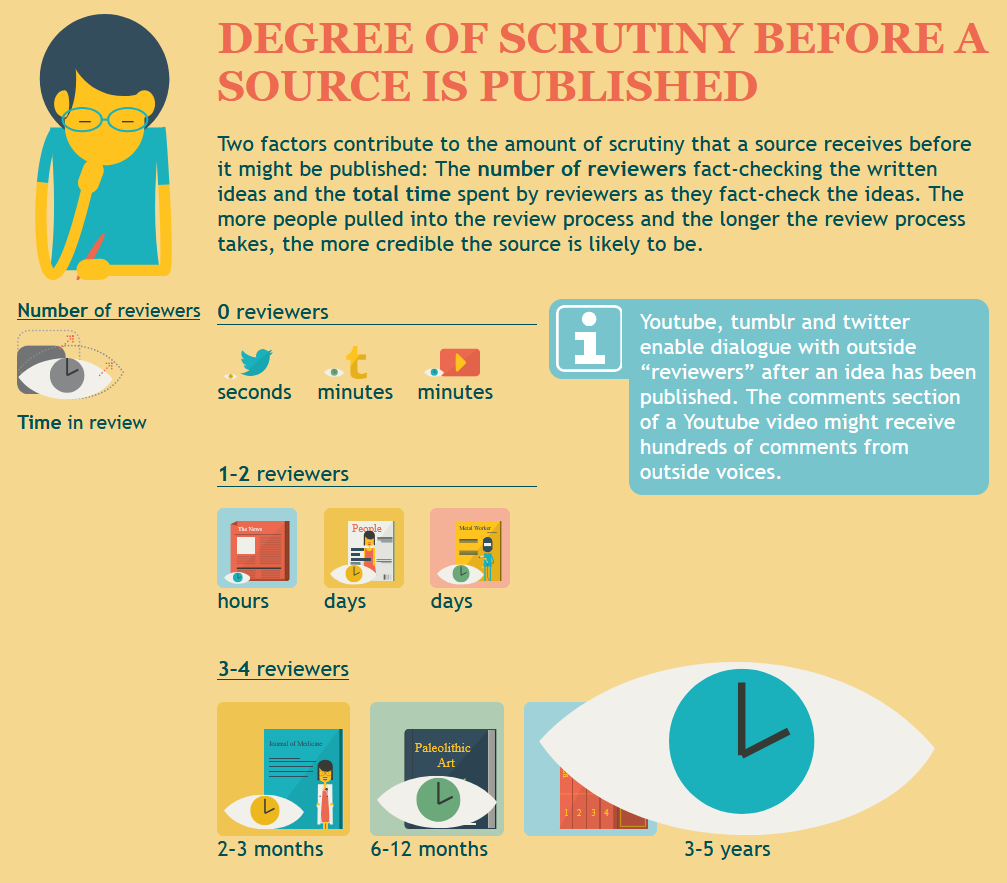
This graphic from the Portland Community College Library highlights how different sources have different review and publication standards. Shared under a CC-BY-NC-SA 4.0 International License.