Mastering Information Evaluation

Image copyright Adobe Stock
Strategies and approaches to evaluating sources and claims
Misinformation and disinformation are not new phenomena, but recent advances in technology have given them new forms such as deepfakes (see our toolkit unit on AI and Deepfakes) and faster channels for spreading. Critical thinking is also not new, but it has become an increasingly important set of skills to develop in an age of information disorder (see our toolkit unit on Misinformation and Disinformation). Critical thinking requires thoughtful engagement with information, and there are various strategies and approaches that can make you more effective at discerning misinformation.
Ethos, Logos, and Pathos
In the field of composition and persuasion, a set of three Greek words — ethos, logos and pathos—are often used to analyze the appeal of the speaker or writer. The same sets of concepts can be applied in the interpretation, analysis, and evaluation of online information.
Ethos refers to how the authority or credibility of the author is established. Questions to ask include:
- Does the author demonstrate familiarity with different opinions and perspectives?
- Does the author speak respectfully about people who may have different perspectives?
- Does the person acknowledge that an issue may be complex or multifaceted?
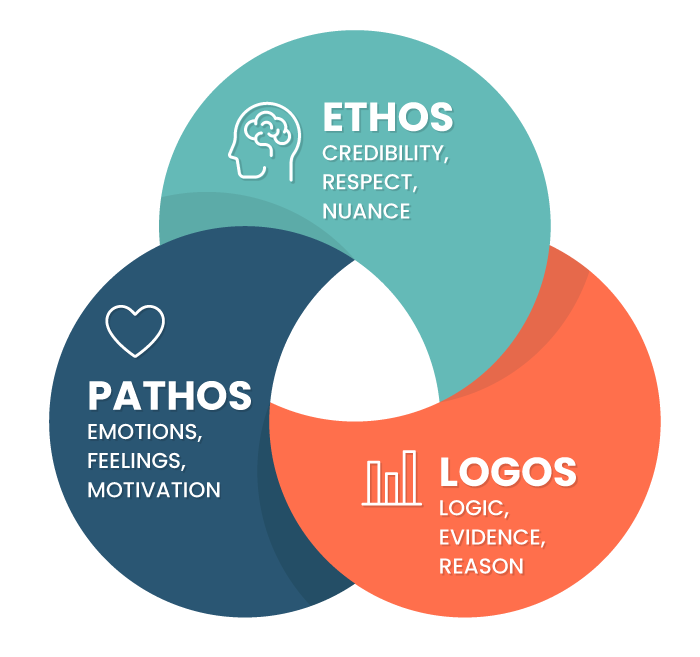
The rhetorical triangle
Logos refers to how logical the argument is and how supported it is by evidence. Questions to ask include:
- Does the conclusion follow logically from the premises?
- Is there sufficient, typical, accurate, and relevant evidence to support the claim?
- Are there attempts to divert your attention from the real issues?
Pathos refers to how emotions are evoked to connect to the audience's attitudes, beliefs, and values. Questions to ask include:
- Does it manipulate the audience's feelings and emotions through fallacious, misleading, or excessively emotional appeals?
- Are emotional appeals used to replace reason and evidence-based arguments?
Adapted from Evaluating appeals to ethos, logos, and pathos by Lumen Learning, under a CC-BY 4.0 International License.
Critical Media Literacy
In the field of communication and journalism, where misinformation and disinformation are often rampant, the concept of critical media literacy has emerged to address the hidden mechanics driving the mass media landscape of news, information, and entertainment. It empowers you to move from being a passive consumer of media to becoming an engaged critic and/or creator (Project Censored & The Media Revolution Collective, 2022).
The media and me: A guide to critical media literacy for young people, uses the difference between telling time versus understanding how the clock works to explain the difference between consuming news passively and making efforts to understand how news media work proactively. It offers some practical steps that you can take to become a more critical user of digital media, which include:
Engage with media at a slower pace
- Engage the media at a pace that makes sense for you, rather than at a speed dictated by media producers or peer pressure.
- Slowing down creates opportunities for critical reflection and analysis, makes room to become more aware of clickbait headlines, worn-out stereotypes, and provocative images.
- The idea of digital minimalism with some core principles that include: Missing out is not negative, less can be more, digital clutter is stressful, attention is scarce and fragile, and activity trumps passivity.
Increase the amount of valuable content
- Some media content has great value while others have less. You have the power to choose the content that you value, be it a desire to laugh, or to learn about what is going on in the world.
- The documentary Project Censored The Movie: Ending the Reign of Junk Food draws attention to the "junk food" in your news diet.
Acknowledge the context
- What is the background of the media producer? Go beyond the content of the media so you can try to see how the context shapes the content.
- The Propwatch Project provides useful examples of propaganda techniques such as oversimplification and distractions & diversions.
Never forget the means of production
- Investigate who owns the media that you use and who sponsors the content you engage with, or simply put, to "follow the money". Look for conflicts of interest that may limit or shape media narratives.
- The DeSmog website analyzes attempts by the fuel and gas industry to discredit science and climate change.
A video on digital literacy strategies with Jane Lytvynenko and Mike Caulfield. The other videos in the playlist are also relevant.
SIFT: The four moves to source and claim checking
Let’s go into the details of a simple but systematic approach to help you evaluate online information.
The SIFT strategy is similar to lateral reading, but offers a more structured way for you to think and analyze sources and context. SIFT stands for:
- Stop
- Investigate the Source
- Find better coverage
- Trace claims, quotes and media to the original context.
You are not expected to do ground-breaking research, but some very quick checks can go a long way.
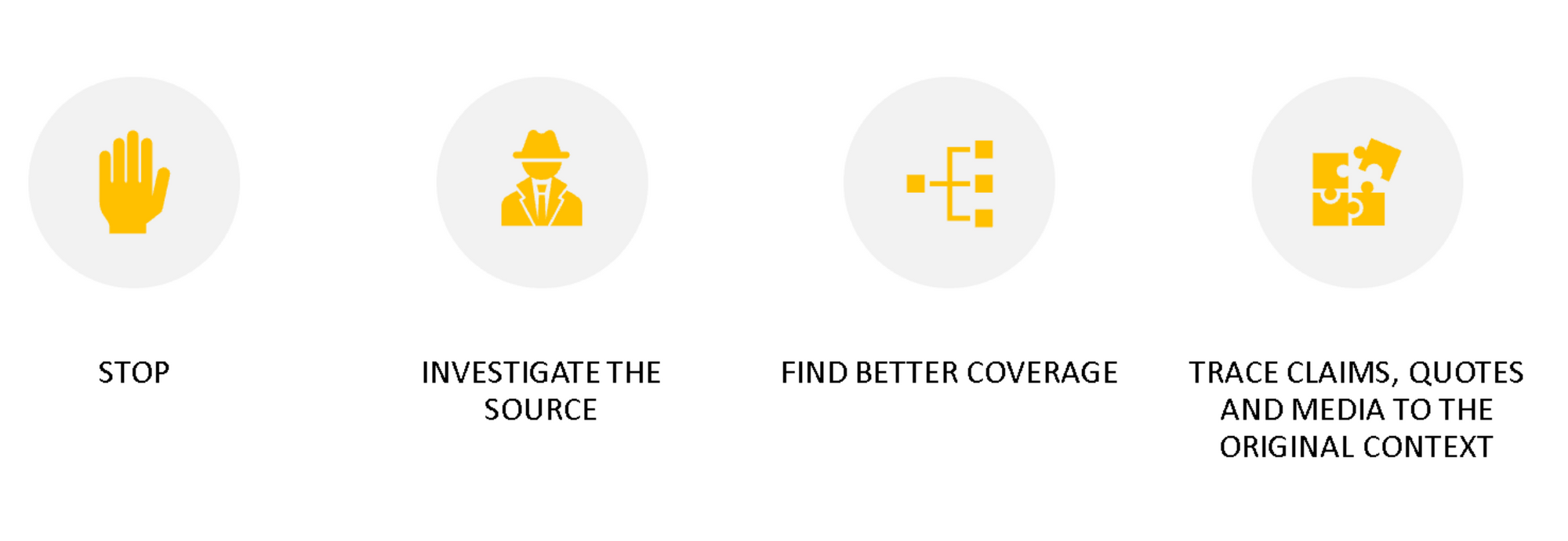
The SIFT method diagram by Mike Caulfield, used under a CC BY 4.0 international license.
Stop
Don’t get lost in the “click cycle”. If you feel yourself getting overwhelmed in your fact-checking efforts, STOP and take a second to remind yourself what your goal is. Adjust your strategy if it isn't working. Make sure you approach the problem at the right amount of depth for your purpose.
Quick tip: Stop before you reflexively click the top search result. You want to take a second or two to make sure you're clicking the best result, not just the first one you see.
Investigate the source
Know what you are reading BEFORE you read it. You are not expected to do investigative journalism into a source, but taking sixty seconds to figure out where it is from before reading will help you decide if it is worth your time, and if it is, help you to better understand its significance and trustworthiness.
Quick tip: Consider bias vs. agenda. Personal bias has real impacts. But bias isn’t agenda, and it's agenda that should be your primary concern for quick checks. Bias is about how people see things; agenda is about what a news or research organization is set up to do. A site that clearly marks opinion columns as opinion, employs dozens of fact-checkers, hires professional reporters, and takes care to be transparent about sources, methods, and conflicts of interest is less likely to be driven by political agenda than a site that does not do these things. And this holds true even if the reporters themselves may have personal bias. Good process and good culture goes a long way to mitigating personal bias.
Find better (trusted) coverage
Not sure if a particular claim from a source is true? Your best strategy is to ignore the current source and look for other trusted reporting or analysis on the claim. As well, scan multiple sources to see what the consensus seems to be. Understanding the context and history of a claim will help you better evaluate it.
Quick tip: Trading up. You can use social media to discover stories relevant to you, but when you find the stories, take a moment to "zoom out" and get the best reporting or analysis on it, rather than simply reading the specific article that happens to find its way to you. When you use social media in this way, you let social media do what it does best (personalized topic discovery) while relying on either news or other search to address social media's big problem (credibility, clickbait, manipulation).
Trace claims, quotes, and media back to the original context
A lot of information on the internet has been stripped of context. A video or a photo could be used in entirely different contexts for different purposes. Tracing something back to where it appears originally is crucial in assessing how accurate or reliable it is.
Quick tip: As with so many things, the truth is a bit more nuanced than it appears at first. And while knowing the original context may not change your opinion on a particular issue, understanding it will help better focus your efforts on the things you care about, no matter which side of the issue you find yourself on.
Like shopping for healthy food, you go around the supermarket and you look at the nutrition labels. The question is not "Is this the only thing I will eat?" The question is "Is this healthy enough to go in the shopping cart?”
Uncertainty and information overload
"Being a critical thinker does not mean you have some magic potion for truth-seeking. Critical thinkers still struggle with evaluating information and even the best critical thinkers are sometimes fooled by the media's messages. Critical thinkers do at least one distinct thing that sets them apart: they keep asking questions, even if (especially when!) they may stumble over the answers." (Project Censored, 2022, p. 43)
There is a difference between skepticism and cynicism. Skepticism based on active engagement and careful considerations of mass media is part of being a critical thinker. However, media overload such as doomscrolling and catastrophic thinking are not to be encouraged as they may be damaging to our mental well-being. (Huff, 2022)
In the end, a few final thoughts to keep in mind: Keep a healthy amount of skepticism, an acknowledgement of the uncertainty and complexity of information at hand, and a recognition that critical engagement with the information could be uncomfortable but so crucial.
Resources

References
Caulfield, Mike. SIFT (The Four Moves). Hapgood. 2019.
Huff, Charlott. Media Overload Is Hurting Our Mental Health. Here Are Ways To Manage Headline Stress. American Psychological Association blog. November 1 2022.
Project Censored and the Media Revolution Collective. The Media and Me: A Guide to Critical Media Literacy for Young People. 2022.