Open Access


Introduction
We’ve all had that feeling of frustration when hitting a paywall while browsing online. However, this experience might become less frequent in the future, at least for research publications and educational information. Open access (OA) is a publishing practice that increases the accessibility of information. In 2001, the Budapest Open Access Initiative clearly defined the overarching goal of OA: that research should be free and accessible to anyone with an internet connection. OA aims to remove barriers to accessing scholarly literature, which in turn facilitates research progress, and enriches teaching and learning. The root of OA is built on the belief that knowledge is a public good; it should be shared with all those who wish to access it. It emphasizes the ideals of transparency in publishing and equity in access. However, in practice, OA often replicates existing inequities in access to information (see the Quick Things page on accessibility) and exclusion of voices from published discourse. The OA movement has several branches, including Open Publication, Open Data, and Open Educational Resources (OER).
Open data
Open data fosters transparency and reproducibility, which is considered the gold standard of scientific research. Open data is an umbrella term that embraces many good practices in research, such as sharing research data and notes, conducting research with sound methods, recording detailed lab notes, documents survey instruments, etc. Another facet of open data is the public perspective. Researchers often receive funding from provincial and federal public agencies, and therefore the outputs of their research should be transparent and accessible by the public.
This video gives you a quick and easy explanation of open date. Authors: Ina Bäckström, Ilya Kompasov, Jana Eberwein In cooperation with Wikimedia Sverige. CC BY
Open educational resources
Open Educational Resources include textbooks, media, lesson plans, quizzes, etc. that can be freely accessed, shared, adapted, and repurposed because they are made available online through the public domain or Creative Commons Licenses. Among many benefits, one significant advantage of OER is their potential to reduce or eliminate the high prices that university students pay for textbooks and other study materials. More information on OER can be found on the Concordia Library OER guide.
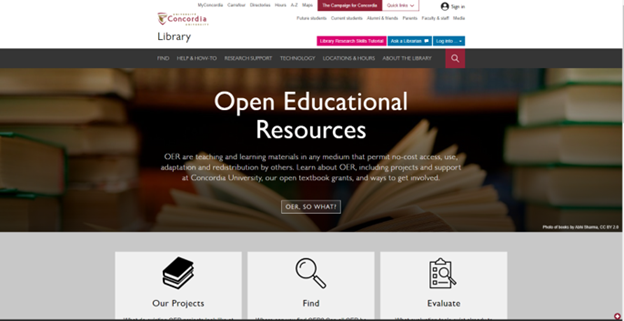
click image to enlarge
Conclusion
OA refers to a set of practices related to distributing scholarly outputs, educational resources, and other publications digitally at no cost to readers. The overarching goal of OA is to provide access to knowledge as a public good. Imagine: what would the world be like if all published information, including university textbooks, were available for free? However, there are critiques of OA as well, including that it upholds historical hierarchies and exclusion, and doesn’t truly allow everyone to contribute or benefit. Do you see any drawbacks to OA?
Open publication
Open publication refers to free and unlimited access to research outputs such as journal articles, theses, and books. Open publication can greatly increase the pace of scientific research. For example, the majority of academic publishers removed access barriers to COVID-19 articles, contributing to the quick development of COVID vaccines. Open publication expands reader diversity, which potentially stimulates collaboration between different domains and fosters innovation.
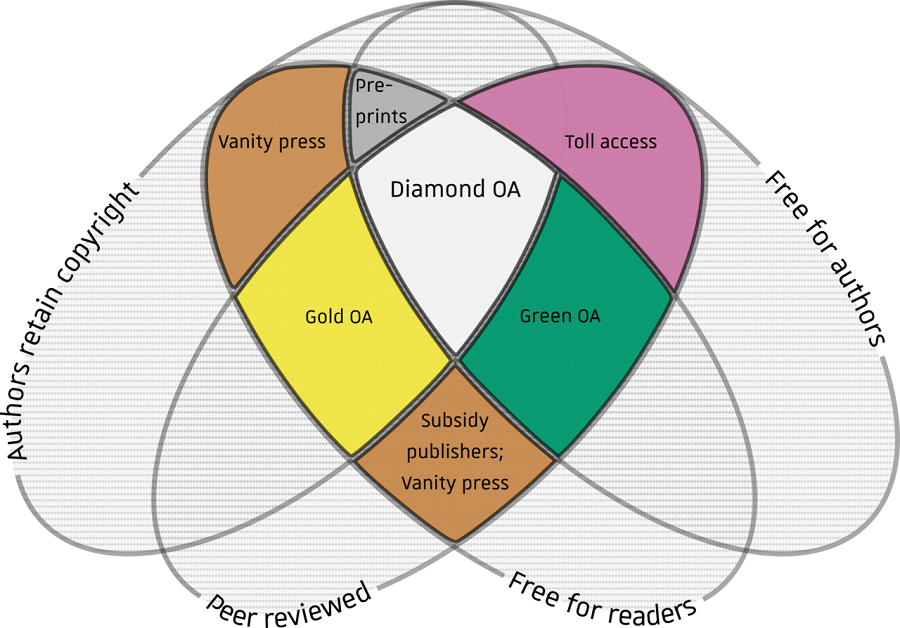
Image source: Farquharson, J. I. and Wadsworth, F. B. Introducing Volcanica: The First Diamond Open-Access Journal For Volcanology. Volcanica 2018 1(1): i-ix.
Because of these evident advantages, open publication has been widely adopted in many countries. In Canada, public funding agencies such as SSHRC, NSERC, and CIHR require that funding recipients publish their research outputs in an open format within 12 months of publication. Fonds de recherche du Québec (FRQ) requires immediate open access availability. Depending on the journal, two of the major types of OA publishing include:
- Gold Open Access: free for everyone to read.
- Green Open Access: a paid subscription is required to access the published article, but authors can make a version of their articles available in repositories for anyone to access for free.
Quiz
Activities

This activity provides you with more resources for finding OER materials.

Explore the list of North American OER policies and projects, and the BC Open Textbook Collection. Find one textbook or other material related to a course you’re taking now.

This activity should take about 15 minutes to complete.
Let’s reflect on the significance of Open Access for creating greater access to knowledge.
Read the plain English summary of this article on the public rationale for open access medical research publishing and the conclusion. Write a short reflection on this topic (150-200 words) about how the availability of open access publications has affected or might affect your life in the future.
This activity should take about 15-20 minutes to complete.
Are you an undergraduate student participating in the FutureBound program?
After reviewing the content and completing the activities for one of
the Things, you can complete a
reflection form
to have it count as one activity towards your
Digital Capabilities & Mindsets certificate!
Resources

Open access takes flight
A feature article in the journal Science about open access publishing, specifically in the context of mandates by funding agencies to make research findings available to all.
See more

OER by discipline
Concordia Library’s guide to open textbooks and other resources by subject area.
See moreReferences
Chalmers, R. Explainer: What Is the Open Movement”. The Conversation, 2012 October 28.
University of Edinburgh. Thing 12: Open Educational Resources. 23 Things for Digital Knowledge, 2016.
Wikipedia. Open access. 2022
Farquharson, J. I. and Wadsworth, F. B. Introducing Volcanica: The First Diamond Open-Access Journal For Volcanology. Volcanica 2018 1(1): i-ix.