ChatGPT & Generative AI


Introduction
ChatGPT is a general purpose chatbot from OpenAI that uses a specific type of artificial intelligence (AI) known as generative AI. More about different types of AI will be discussed below, but from a simple user perspective, ChatGPT interacts with you to provide human-like responses to prompts or queries. It can generate answers to questions, summarize concepts, create poems, write computer code, draft essays or emails, simulate a text-based conversation, and much more.
Consider these suggestions for 48 possible uses of OpenAI’s tools, including ChatGPT.
GPT stands for “Generative Pre-Trained Transformer,” which is an example of a machine learning model that can generate new data. This means it is not fetching data and serving it up like old-school chatbots, but instead has been trained using a massive amount of data in such a way that it is actually generating a unique response to your query or prompt “on-the-fly.” There has been intense interest in ChatGPT due to the impressive breadth, depth and natural language ability compared to earlier chatbots.
ChatGPT is not the only generative AI system. For example, some like DALL-E and Stable Diffusion generate images from text, and others can be used for sound. Machine learning models are used for translation, math, and a wide variety of purposes, and generative AI has been integrated in search engines like Microsoft's Copilot.
This Quick Thing provides introductory information about using generative AI such as ChatGPT within the context of academic work. The following examples are starting points for reflecting on possible uses for new AI tools and why to be cautious.
Examples
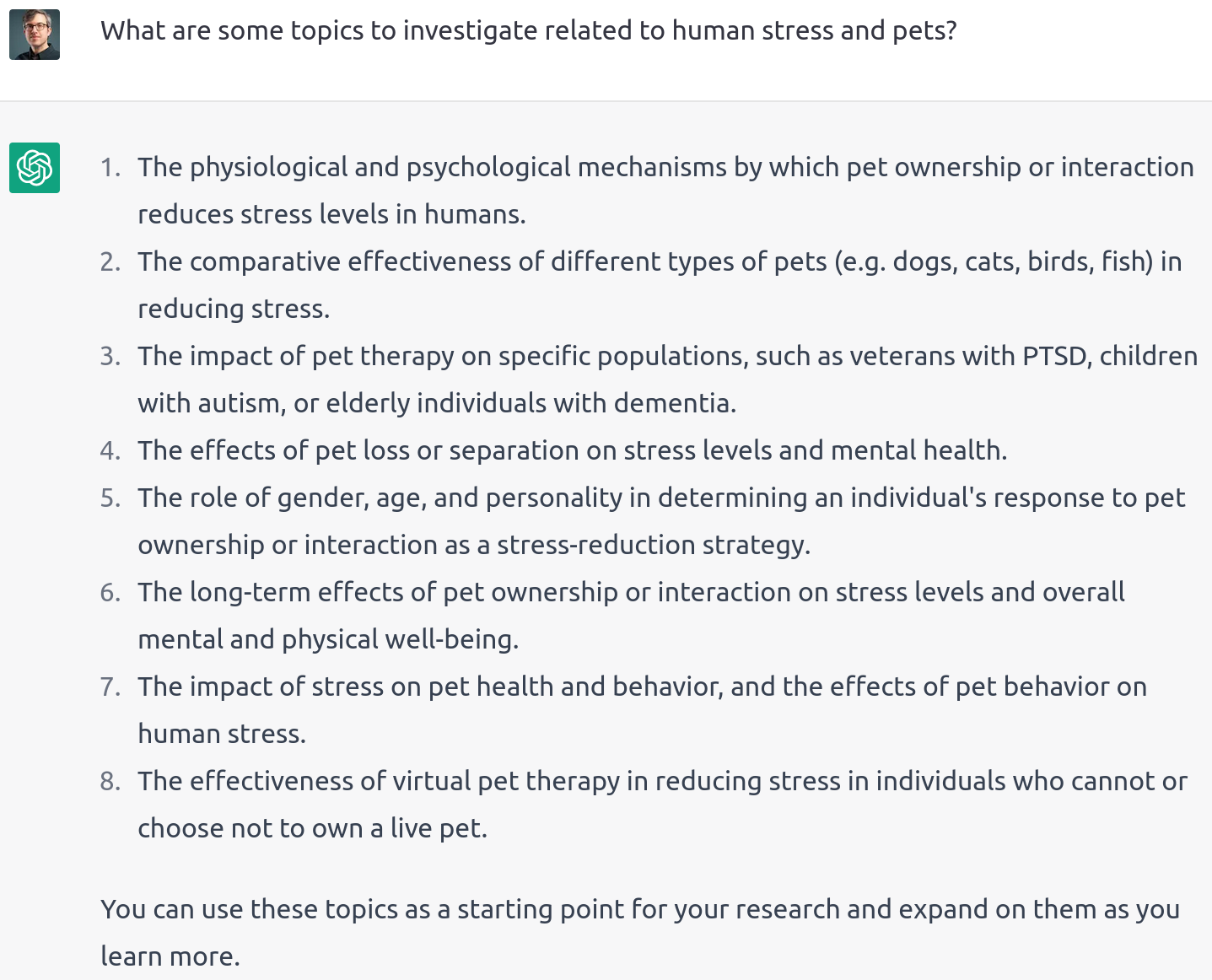
A prompt and the response generated by OpenAI’s ChatGPT (January 2023)
A Possibly Useful Example
Tools like ChatGPT can be helpful as aids to brainstorm for a project or assignment. If you would like to explore different perspectives or ideas beyond your own thoughts, you could try asking the machine.
Suppose you're interested in the relationship that humans have with pets and how stress figures into that relationship, but you have not yet decided on a focus. You could ask ChatGPT “What are some topics to investigate related to human stress and pets?” It would respond with possibilities that you could consider, adapt, and refine.
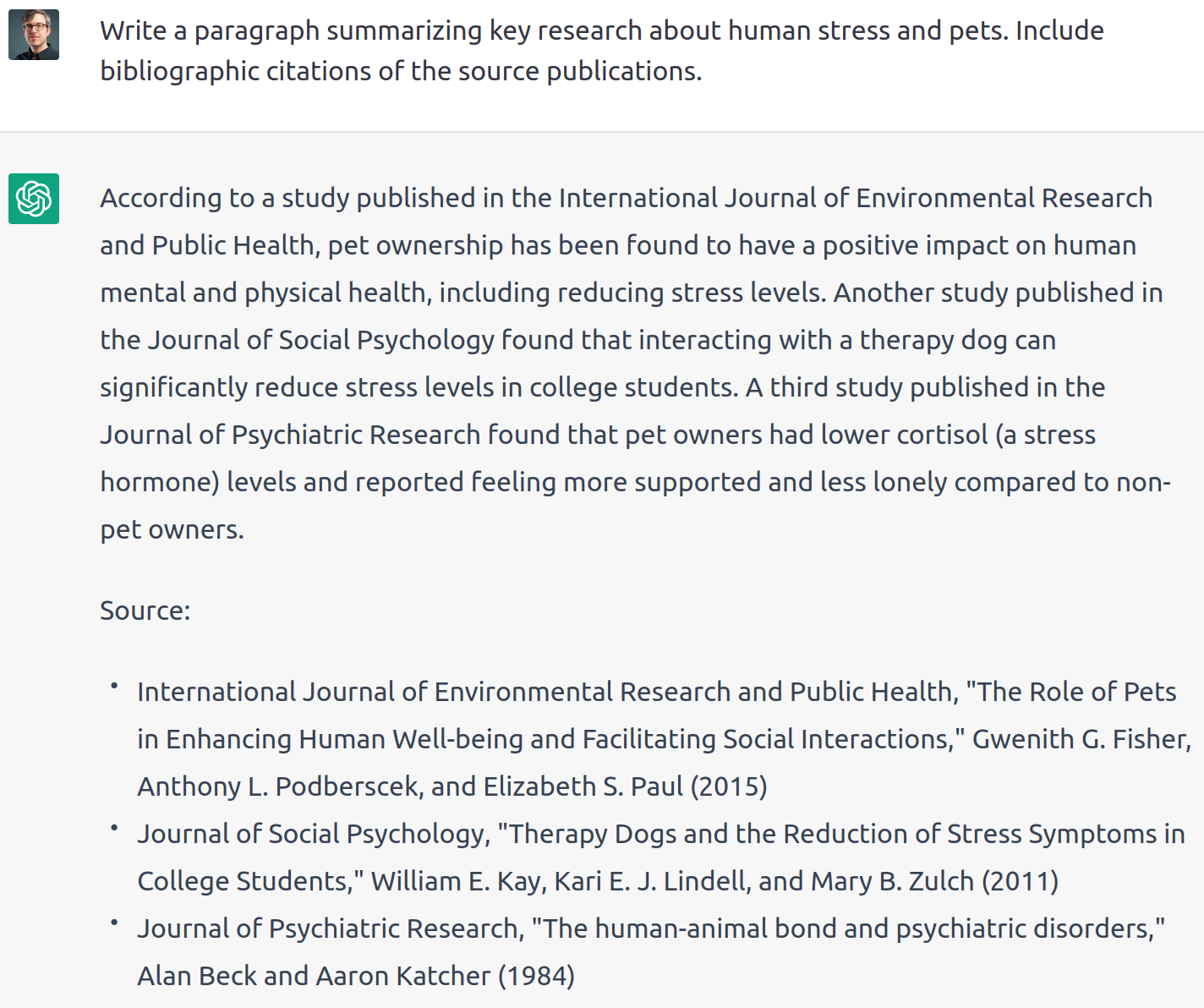
A prompt and ChatGPT's response (January 2023). Writing seems plausible, but sources don't exist.
A Not So Useful Example!
Remember the "generative" aspect of these tools? Although they may often provide you with good quality information, they will also provide you with misleading or fictitious information. In this example, asking ChatGPT to summarize key research with citations about human stress and pets produced a realistic sounding result and even provided citations as though academic sources support the summary provided. But while the writing seems plausible, the sources cited don’t actually exist!
Types of AI and what "generative" means
Two well-known types of AI are predictive and generative machine learning models. The models’ algorithms determine patterns in a training dataset, which “teaches” the models what to do when they encounter new data that fit these patterns. (See our Quick Thing on Machine Learning for different types of training/learning methods.)
Predictive models use patterns in data to make predictions very quickly. They are used, for example, on shopping sites and streaming video services to suggest what to buy or view based on your past habits or the choices of others with similar habits. Other usage examples include doing sentiment analysis of large corpuses of text, filtering spam, detecting diseases from medical images, and flagging fake news.
Generative models use patterns in data to create new content. The intention of the model is not accuracy or truth or beauty … but rather to generate new text or images or sound that is equivalent in form to what humans can write or create.
Large Language Models (LLM) such as GPT are examples of generative AI. An LLM uses probabilities derived from sequences of words from a very large corpus of text to determine what words should come next as responses are generated one word at a time. To give an idea of the dimension of the training dataset, the GPT-3 model released in 2022 was trained using almost 500 billion words from the public internet, including internet-based books and all of Wikipedia (Brown et al, 2020).
The key point to know about generative AI is that there is no reasoning used when it answers a prompt. For example, even with the so-called “reasoning models,” ChatGPT is not thinking (rationally or creatively) when it is responding to your question or instructions—it is generating text based on what it has “learned” about patterns and sequences of words derived from the human-created work in its training dataset. It then generates text that simulates these patterns. With such a large dataset and a human reinforcement technique used for its training, ChatGPT can generate responses that are impressively human-like, often “correct” in form, and sometimes wrong and/or misleading.
This YouTube video gives an overview of ChatGPT, including capabilities and some important limitations. By: How It Happened.
Pitfalls of generative AI
In addition to the text and image generating tools already mentioned, generative AI can be used to create deepfakes, which are "believable media generated by a deep neural network" (Mirsky & Lee, 2022). Deepfakes are image, video, or audio content that seem indistinguishable from real humans. While these may offer new creative possibilities, they can also be used for deliberately misleading viewers.
The prevalence of hallucinations or confabulations, or false information, is a significant and sometimes amusing limitation to tools like ChatGPT. Because it’s a language model, not a web search engine, it creates new text based on the dataset used to train it. In other words, it identifies and imitates patterns.
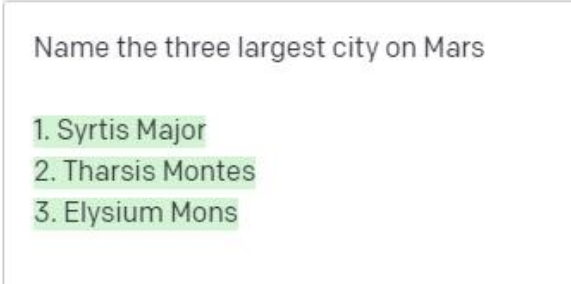
A prompt and GPT-3's response (January 2023)—a hallucination. The regions may exist, but these aren’t cities!
Algorithmic bias refers to “...the algorithm inappropriately privileging or disadvantaging one group of users over another group” (Turing Institute, 2023). Algorithmic bias results from what data was included and excluded in the dataset used to train the machine learning model. Marginalized groups tend to be less represented in training data, or they may be subject to societal bias that is embedded in the training data. Thus, the sources and methods of acquiring the training data can skew results and perpetuate biases that exist in society (Bender et al, 2021). In addition, when trained from data provided by online communities that express toxic content, the model can produce misinformation, disinformation, and unintended outputs that are likewise toxic.
Conclusion
Certainly, there are many positive ways in which AI tools like ChatGPT can and will be used in academic and research settings. ChatGPT is an impressive example of what AI is capable of today, and hints at what may be possible in the future. Many see the release of ChatGPT as a pivotal moment in the widespread application and use of generative artificial intelligence.
That said, to take full advantage of AI in your learning or work, you still need to understand your subject matter well enough that you can both guide the tool as well as critically assess its output. This means that generative AI tools like ChatGPT cannot replace the necessity of developing your own knowledge on a subject and exercising deep critical thinking skills.
Recommended readings to learn more about ChatGPT
Curious about machine learning and AI terminology? Try Google's Machine Learning Glossary or DataFranca's French-language AI dictionary (and apps).
Centre for Teaching & Learning, Concordia University. (2026). Guidelines for teaching with generative AI.
OpenAI. (2026). ChatGPT FAQ.
A selection of short articles about ChatGPT in higher education. (2022-present). The Conversation.
Mollick, E. (2026, February 17). A guide to which AI to use in the agentic era. One Useful Things.
Bergstrom, C. T., & West, J. D. (2025). Modern day oracles or bullshit machines? How to thrive in a ChatGPT world.
Quiz
Activities

Experiment with writing prompts for image creation. Gain some familiarity with the possibilities and limitations of using a text-to-image generative AI tool.

Suppose you were assigned to do a presentation about a topic. Can you use a text-to-image AI tool to help illustrate an idea you’d like to cover in the presentation?
- Navigate to the free text-to-image tool OpenJourney.
- Write a prompt that asks OpenJourney to generate an image representing something from your research. Type your prompt in the “Text-to-image" box and click the “Compute” button. Did the result make sense? Did it surprise you?
- Can you refine the image to be better? Try changing the words in your prompt. What happens if you ask it to make a diagram? A textbook illustration? Something photorealistic?
- Did any of the images lead you to question the data sources that were used to train this model?

This activity should take about 10-15 minutes to complete.
Explore a generative AI tool to brainstorm ideas and get relevant guidance on literature to read.
Use Elicit.org (an AI-supported interface for searching and reviewing scholarly literature) to brainstorm a topic and find three important articles on that topic. Verify that the sources of the articles exists. Note that because Elicit relies on a large language model, the literature summaries it provides may not be fully accurate.
- Sign up for a free account on Elicit.
- Explore a research question by typing some words or your question into Elicit’s main search box.
- Read the summary of what Elicit refers to as the top papers related to the question. The summary appears in the upper left of the interface.
- Verify if two or three of the articles actually exist by downloading them from the links provided or search them from the Library’s website.
- For one of the articles, consider: does the summary cover the key content of the paper or did it miss the point? Can you spot errors in the summary?
This activity should take about 20 minutes to complete.
Are you an undergraduate student participating in the FutureBound program?
After reviewing the content and completing the
activities for one of
the Things, you can complete a
reflection form
to have it count as one activity towards your
Digital Capabilities & Mindsets certificate!
Resources

Generative A.I. with Python and Pytorch
Learn to code the most creative and exciting A.I. architectures, generative networks, from basic to advanced and beyond.
See more
What's in the Chatterbox?
This one-page document summarizes some societal implications of large language models (LLMs) like ChatGPT. It also links to the full report describing how LLMs work and how this technology might impact us.
See more
Why AI Isn’t as Good at Writing as You Think
This video considers the possibilities and shortcomings of writing with AI and presents arguments for why the human aspects of writing and interpreting text are unlikely to be replaced by AI soon.
See moreReferences
Brown, T., Mann, B., Ryder, N., Subbiah, M., Kaplan, J. D., Dhariwal, P., ... & Amodei, D. (2020). Language Models are Few-Shot Learners. Advances in Neural Information Processing Systems, 33, 1877-1901.
Data Science and AI Glossary. The Alan Turing Institute, 2023.
Mirsky, Yisroel, and Wenke Lee. The Creation and Detection of Deepfakes: A Survey. ACM Computing Surveys 54, no. 1 (January 2022): 1–41.
Bender, Emily M., Timnit Gebru, Angelina McMillan-Major, and Shmargaret Shmitchell. On the Dangers of Stochastic Parrots: Can Language Models Be Too Big? In Proceedings of the 2021 ACM Conference on Fairness, Accountability, and Transparency, 610–23. FAccT ’21. New York, NY, USA: Association for Computing Machinery, 2021.