Extended Reality


Introduction
In 2016, Niantic released Pokémon Go, an augmented (AR) reality video game for mobile devices. By overlaying creatures and game mechanics on top of the live camera feed from the mobile device, and connecting devices to each other, Pokémon Go gave many people their first commercial experience of extended reality (XR), highlighting its social, interactive, and artistic potentials. XR also includes Virtual Reality (VR) and Mixed Reality (MR).
XR changes how we perceive and interact with the world around us. It has made an impact in construction, medical, entertainment and exploration industries, amongst many others. The latest cycle of research and devices, from the metaverse to Apple’s latest Vision Pro headset, has attracted substantial investments and equally creative engineers. But where do these tools come from, and how can we engage with them from a critical perspective?
What is XR?
XR or "Extended Reality" is an umbrella term used to describe technologies that blend digital experiences with physical reality. While many innovative XR technologies are becoming increasingly mainstream, some of the ideas underlying VR and AR technologies can be traced back to the 1800s and stereoscopic displays, which play with vision. These early devices made it possible to capture and represent the world in 3D images using mirrors and refracting prisms. The Crash Course: Future of VR episode has a more detailed look at the history of VR (video includes transcript).
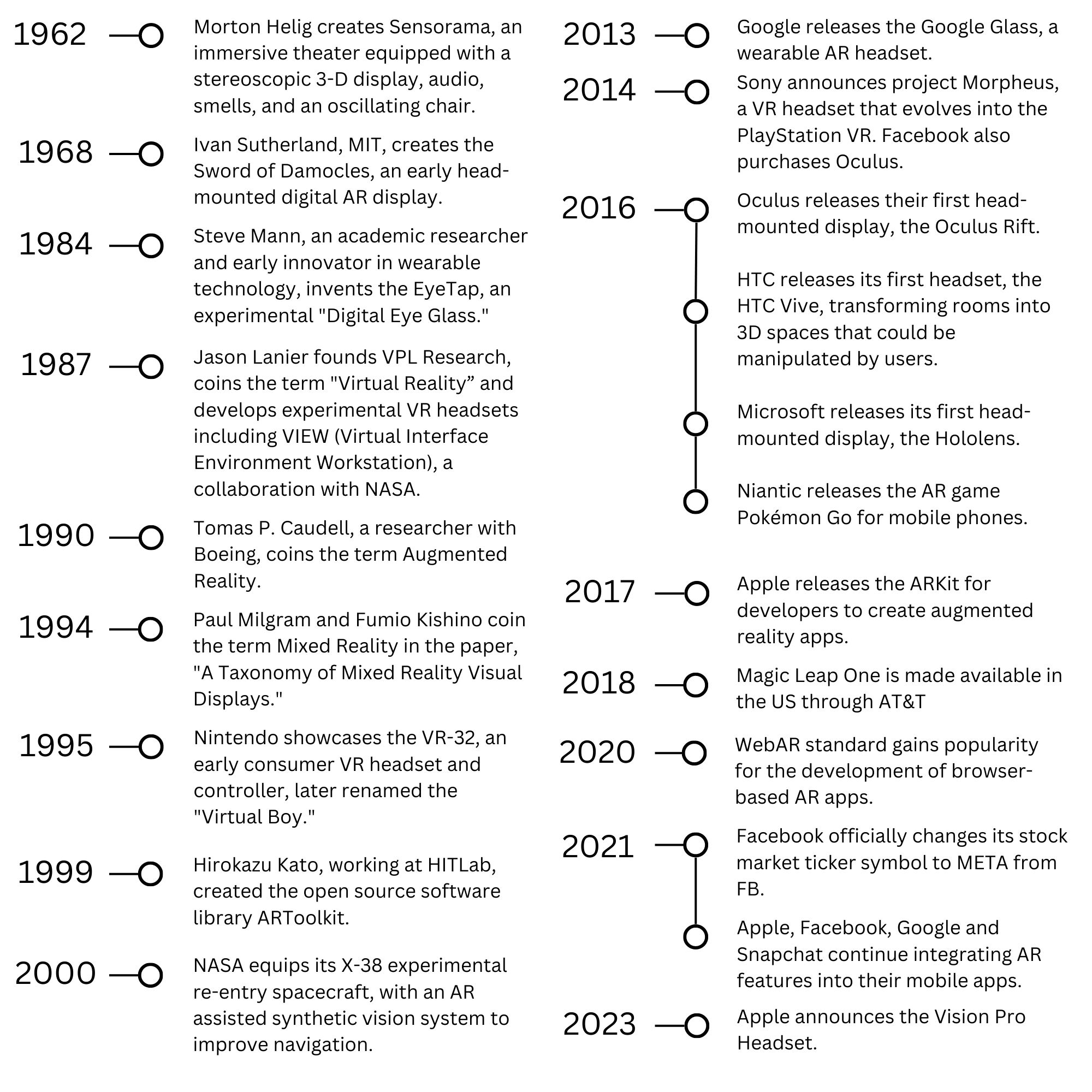
A timeline for immersive technologies from 1962 to today.
What's the difference between AR, VR and MR?
Technologies that fall under the term XR provide us with a more immersive way to interact with digital objects. What do AR, VR, and MR mean?
Virtual Reality (VR) usually relies on a head mounted display with screens for each eye. This allows content creators to generate “stereoscopic” video which translates into a three-dimensional experience. VR devices can immerse a user in real-world 360 video, computer-generated content, or a combination of both; these are usually controlled by handheld remotes. Examples of VR include the video game Second Life, the Mozilla Hubs platform of virtual rooms, or, in fiction, the Star Trek Holodeck.
With Augmented Reality (AR) experiences, digital content is layered on top of the physical world using headsets, smartphones or wearables. With AR, the wearer’s environment can be augmented with text, images, video, sound, and other forms of haptic feedback – just like in Pokémon Go. Other examples include Tiktok’s animated overlays, or Ikea’s app which helps you visualize furniture in a room before buying it.
The defining feature of Mixed Reality (MR), and what differentiates it from AR, is that objects in the physical world and digital content coexist and interact with each other, and with you! For example, Google Translate can overlay translated text over real life script. If you change what is written, the translation will update.
Generally, XR can be thought of as any system which blurs the lines between what is real and what is computationally simulated by making the latter interactive and immersive.
.jpg)
Graphics license CC-BY for the Noun Project, by Arafat Uddin, Path Lord, and Smashicons.
How will XR affect our every day lives?
For some people, XR is already affecting the way they work or live. As mentioned above, translation apps use AR to translate text. Digital maps often let you overlay information over a satellite representation of the terrain surrounding you. Book scanning apps detect the edges of a page and display those in real time on your mobile device to make sure you will get the output you want.
In healthcare, VR helps people get in the shoes of people who perceive the world in different ways or to prepare patients for medical procedures. In retail, brands have, like Ikea, used AR or VR to let curious customers “try out” products before purchasing. In digital arts, some people have reoriented their career towards exploring the artistic potential of these tools, creating immersive experiences, compositions, games, etc.
At research centers, XR technologies are also being used to visualize and explore large datasets. For example, NASA’s PointCloudsVR is used to map and explore star system information gathered by orbital satellites. Finally, various museums provide high resolution tours of their collections in immersive formats, making their collection remotely accessible.
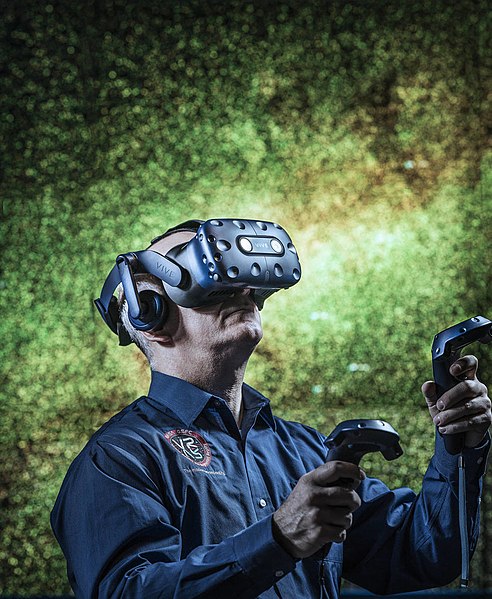
NASA engineer Tom Grubb manipulates a 3D simulation that animates the speed and direction of four million stars in the local Milky Way neighborhood using the PointsCloudVR system. CC-By Wikimedia Commons.
Single and Multi-Player Environments
In the 1990’s, VR environments tended to be single-player worlds. Projects such as Second Life (released 2003) popularized the possibility of interacting with other users via avatars in a virtual world, which have since become the norm, and allow for further integration with AR / MR experiences.
In 2021, Facebook changed its name to Meta and publicized its version of a Virtual Reality platform. Learn more from the Web 3.0 and the metaverse Quick Thing.
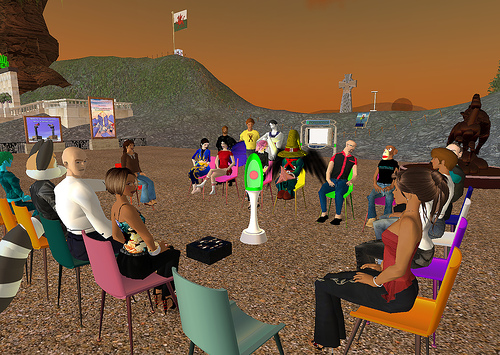
A Meeting in Second Life, one of the original multi-player commercial online meeting environments. CC-BY Wikiversity.
Other Senses and Accessibility
Although head mounted displays are often the technological focus of XR development, various devices have for decades worked with other senses than the visual to provide immersive experiences. For example, there is a whole subset of immersive audio games which replace video environments with purely auditory ones, through which you play using only headphones.
This highlights that XR, although it can provide a very wide range of new experiences for audiences, has accessibility barriers. What would XR designed for d/Deaf and hard of hearing people look like? For people with different mobility needs? For people with low vision or who are blind? These are still areas of active experimentation and research. If you are interested in making immersive experiences accessible and worthwhile, how would you work to include marginalized perspectives?
A Note on Wearables
Wearables are electronics designed to be worn on a variety of human bodies. As XR expands immersion from seeing and hearing to feeling, smelling, and perhaps eventually tasting, wearables will in large part determine how comfortable future technology will be. Correspondingly, wearables are an active field of research.
Resources at the Concordia Library
The Webster Library Technology Sandbox has VR, AR, and MR equipment such as headsets, scanners, and design software as well as a variety of related workshops and assistance.
The Webster Library Visualization Studio also offers VR headsets and an immersive multichannel sound system (full technical specifications).
Quiz
Activities

How do extended reality technologies make real life look like a game, and how can gaming affect our everyday experiences through XR? This activity gives you a chance to think about how XR has made great progress because of its promises in a gaming context, and as a result the boundaries between ludic (playful) activities and practical activities has been blurred.

Watch this Pokémon Go demo.
- What does the app do?
- Is it interactive?
- Can multiple people interact with each other through the app?
- What are the app's XR capacities?
- Are the visual mechanics comparable to Pokémon Go?
- Is it interactive?
- Can it be used socially like Pokémon Go?

It should take about 10 minutes to view the videos and consider the questions.
Are you an undergraduate student participating in the FutureBound program?
After reviewing the content and completing the activities for one of
the Things, you can complete a
reflection form
to have it count as one activity towards your
Digital Capabilities & Mindsets certificate!
Resources

Accessibility of VR experiences
In this article from 2020, the authors discuss the result of their survey of people with limited mobility using VR technology.
See more
Crash Course: Games ep. 21
In this Crash Course: Games episode, Andre Meadows offers a detailed review of VR's history up to 2017.
See moreReferences
Wikipedia. Extended Reality 2022.
Sonali Agarwal, Narinder Singh Punn, Sanjay Kumar Sonbhadra, P. Nagabhushan, Soundra Pandian, Praveer Saxena Unleashing the Power of Disruptive and Emerging Technologies Amid COVID 2019: A Detailed Review, ArXiv Preprint, 2020.
Elaine M. Raybourn, William A. Stubblefield, Michael Trumbo, Aaron Jones, Jon Whetzel, Nathan Fabian. Information Design for XR Immersive Environments: Challenges and Opportunities. In the Proceedings of the Virtual, Augmented and Mixed Reality. Multimodal Interaction: 11th International Conference, VAMR 2019, Orlando, FL, USA, July 26–31 (pp. 153-164), Springer, 2019.
Interaction Design Foundation. Augmented Reality – The Past, The Present and The Future, 2021.
Ivy Wigmor. TechTarget. mixed reality (hybrid reality, extended reality) 2018.