

2025 Webster Library Exhibitions
Exuberant Botanica
August 18 – December 12, 2025
Webster Library LB-2 vitrines and Discovery Counter
In conjunction with the FOFA Gallery exhibition: Hot House/Maison chaude
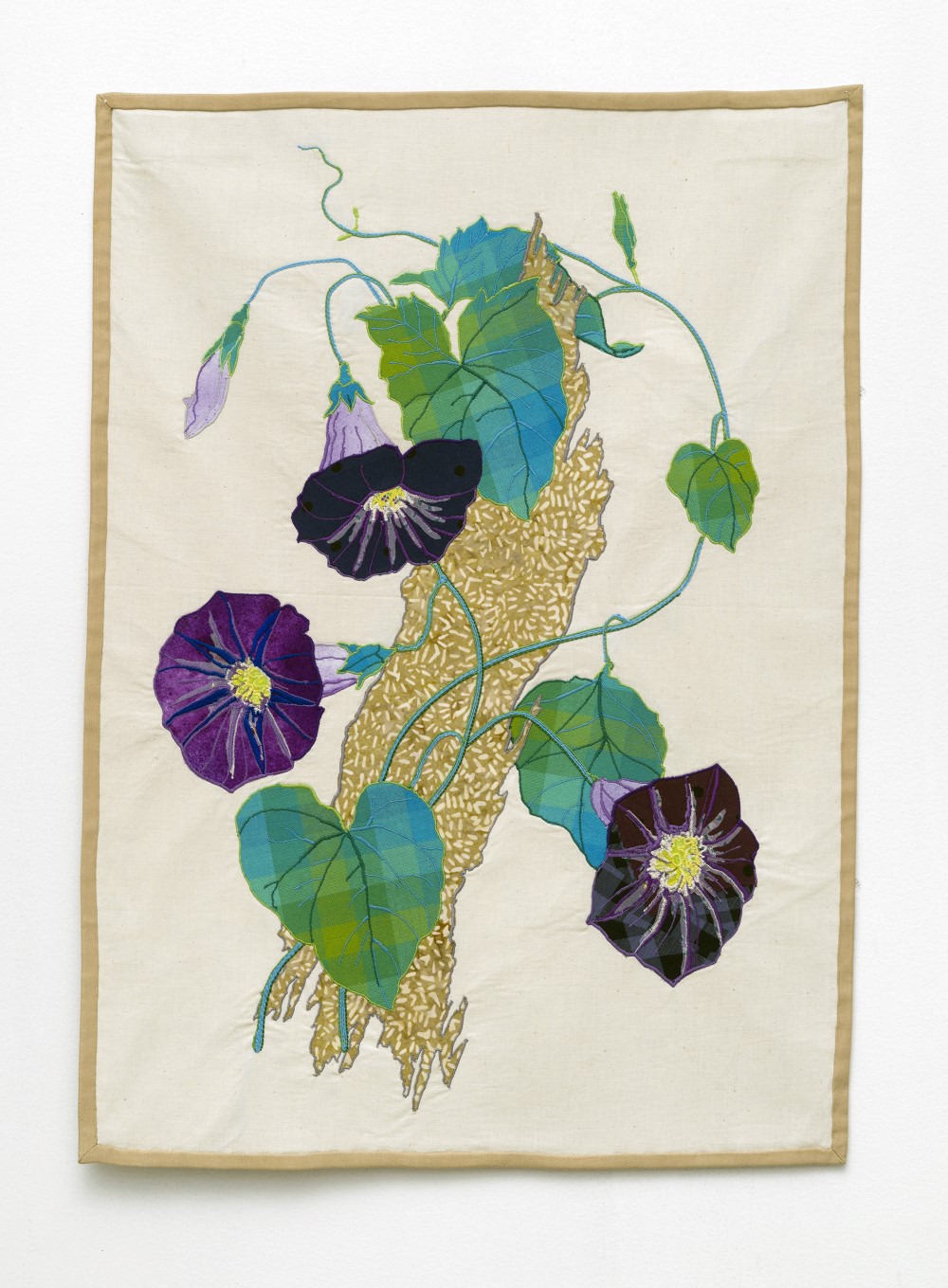
Exuberant Botanica is part of a long-term interdisciplinary project, Hot House/Maison chaude, initiated in 2020 by Aaron McIntosh, Associate Professor in Studio Arts. Rooted in queer ecology, science fiction, ethnobotany, eco-feminism, and social practice, this evolving body of work bridges art, botany, and activism, drawing on scientific, historical, and cultural elements to focus on the needs and identities of queer communities. The project's name is inspired by 19th-century “hot houses” that nurtured rare plant species, paralleling how McIntosh seeks to cultivate spaces for marginalized sexualities and gender identities. The Webster Library vitrines serve as a supplement to the Hot House/Maison chaude exhibition at the FOFA Gallery (Sept. 2 – Dec. 15, 2025, EV Building Room 1.715), showcasing a vast range of botanical texts, including herbal manuscripts and botanical illustrations that have influenced the project.
The second act, Exuberant Botanica, centers on exploring plants that have co-evolved with human sexualities and gender-based medicine. The project takes its name partly from the work of biologist Bruce Bagemihl, whose ground-breaking text, Biological Exuberance1, catalogued hundreds of animal kingdom instances of same-sex relations, from sexual pleasure to pair-bonding and parenting. While Western biology and medicine have often pathologized queer bodies, this project flips the narrative by suggesting queerness is rooted in nature, alongside the diverse gender and sexual patterns already seen in plant life. The project looks to ethnobotany—the study of plants and their uses by people—for plant species that may have evolved alongside humans, serving the mutual benefits of expanding gender and sexual identities.
Botanical illustration was a lodestar in the project's trajectory. This art form, which changes widely across cultural geographies and aesthetic periods, became a scientific teaching tool in the West, dissecting plants into parts, offering a visually abstract representation of nature. Shifting with technological advances in printmaking, science and travel, botanical illustration evolved alongside European empire-expansion and colonizing expeditions, leaving indelible marks on the tradition. Sifting through these texts, McIntosh stumbled on the complex histories of herbal manuscripts, which are the forebearers of both botanic illustration and the precursors to modern pharmacopoeias, many of which were developed by “wise women” and possibly queer individuals. These early works, such as Dioscurides' Codex Vindobonensis, or The Herbal of al-Ghāfiqī, originated from diverse global cultures, providing detailed knowledge about plants and their medicinal uses, especially regarding reproductive and gender health.
The project envisions a “queer herbal” that intertwines the healing properties of plants with the needs of queer and trans communities. McIntosh scoured ancient texts, including Medieval, Renaissance, and Victorian herbals, as well as Appalachian folk remedies, for plants that might have been used covertly by queer people for health, healing, or pleasure. For instance, Morning Glory (Ipomoea) is wide-ranging plant family with historic queer witchcraft connections, as it was administered as a hallucinogen in Medieval Europe, and as a mood-altering substance connected to Xochipilli, the Aztec god of flowers and patron of homosexuals and male prostitutes. In the Victorian-era 'language of flowers', Morning Glory flowers were symbolic of unrequited love, and thus became synonymous with the furtive nature of queer desires.
For pre-modern knowledge-keepers, the herbal was viewed by its owner as a 'living text,' a work-in-progress. The “unfixed” nature of these herbal guides finds resonance in our very contemporary moments of self-determination, reconciliation, and realignment of societal norms. Inspired to build a collaborative herbal for healing contemporary queer and trans community health and well-being issues, I published Exuberant Botanica in 2022. The participatory zine was mailed to 2SLGBTQ+ folk across Turtle Island, and contributors were asked to consider what ails them and to imagine a fictional herbal remedy for this ailment. These participant ideations have since been added to a bound herbal manuscript, and also translated into a series of botanic drawings, appliqué botanic quilts, and sculptural teaching models of speculative plant herbals.
At its core, Exuberant Botanica aims to rekindle humanity's connection with plants and healing, offering a speculative look at the future of queer people and the tools they might need to combat societal issues such as queer violence and discrimination. Through the lens of queer ecology and speculative botany, McIntosh imagines a future where plants can offer not only physical healing but also a form of resistance and resilience in the face of ongoing challenges.
1) Bagemihl, Bruce. 2000. Biological Exuberance: Animal Homosexuality and Natural Diversity. Stonewall Inn Editions.
The artist thanks Concordia University Library and McGill University Library for the loan of botanical books for this exhibition.

Shaping Grief: Quilt and Book
May 1 – August 1, 2025
Webster Library LB-2 vitrines
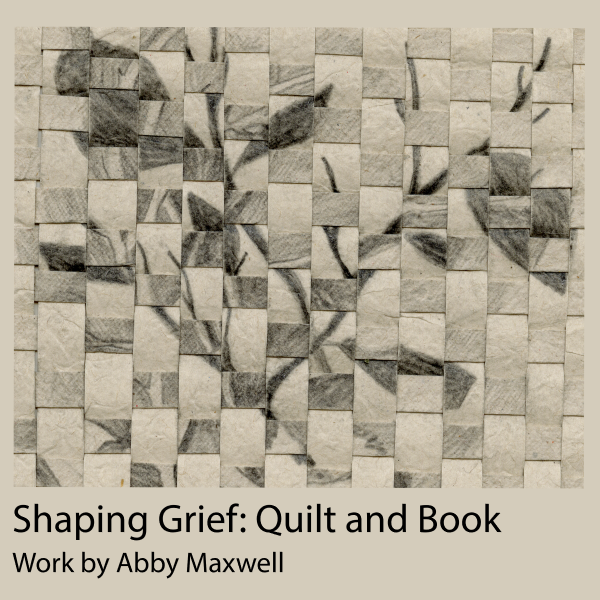
We invite you to experience Shaping Grief: Quilt and Book, an exhibition featuring the work of Abby Maxwell. Through textiles and books, Maxwell explores grief as a material and structural presence—unbound by language yet deeply embedded in memory and decay.
"The collection presented here engages closely with materialities of loss, decay, waste, and remains, made with rust mordants; the pigments of barks, fallen leaves, and grief herbals; the heap of cloth scraps remaining from my own textile practice; pages of disintegrating books on street corners; the silk fluff returning milkweed seeds to the ground. These works attempt to inhabit the form of grief, not to speak its name or tell its story, but to take part in its movement as an essentially limitless and unrepresentable force. I am interested in what is made possible by the forms of the quilt and the book. I consider both techniques of containment as modes of being with the structure of grief–a structure of sheer ineffability; beyond language, beyond narrative, and beyond memory. Both quilts and books tend to be taken up as vessels for these very notions: they contain and maintain information that is meant to carry memory (history, tradition) into the future. Yet, they are assemblages of bound fibre–they are essentially fleeting; bound for decay." -- Abby Maxwell.
FREE BOOKS: Open Publishing at Concordia
March 3 – April 30, 2025
Webster Library LB-2 vitrines and Discovery Counter
To celebrate Open Education Month, Concordia Library is pleased to present a new display highlighting open publishing at the Library and Concordia University Press (CUP). Together, the Library and CUP collaborate to make scholarship and education free and accessible within and beyond the university.
Open educational Resources (OER) are digital resources for teaching, learning, and research that are made available for use and re-purposing. They increase the variety of instructional resources in students’ learning experiences while lowering the financial barriers. OER in the form of open textbooks are a hallmark of Concordia’s OER program. Although open-access publications from university presses often do not permit repurposing in the same way that open textbooks do, they are nonetheless free for students and can be adopted in courses. In parallel with open publishing, Course Reserves also offer a free option for students.
This collaborative display illustrates how open education and open scholarship can nurture each other. As higher education becomes increasingly costly, students stand to gain from the cost-saving benefits of viable alternatives to commercial textbooks. Meanwhile, professors can choose to deepen their research and pedagogical impact by developing open-access and knowledge-mobilization plans to benefit students and the wider public.
Organized in six sections, this display introduces students and faculty to the parallels between CUP and the Library’s OER program. In the vitrine and the digital counter, you will find awareness efforts alongside physical and digital books from CUP and Concordia’s OER program. QR codes make these titles easily accessible, while OER and CUP buttons and slogans promote the importance of open publishing.
Finally, the horizons of free course material options can be expanded through student advocacy and faculty pedagogy. We encourage students to nominate a course for open education and show their support for open publishing by wearing one of our buttons found at the Ask-Us Desk. We encourage faculty to consider open textbook grants, course reserves, and open-access university presses.
Let's reduce barriers to higher education together!
Curated by the Library’s OER Team and Concordia University Press, the exhibition will be on display from March 3 until April 30, 2025. Special thanks to Zo Kopyna, Chhayhee Sok, Saelan Twerdy, and Meredith Carruthers. - Rachel Harris
Concordia University Library supports open scholarship, education, and science. As part of this commitment, the Library leads the University’s OER Program and continues to develop open scholarship initiatives and services, such as our open guides and institutional repository.
Concordia University Press is a non-profit publisher of peer-reviewed books. Concordia University Press is committed to barrier-free scholarship and our titles are available as free, open-access e-books, as well as for sale in thoughtfully designed print editions.